MandibularOval
Mandibular First Premolar
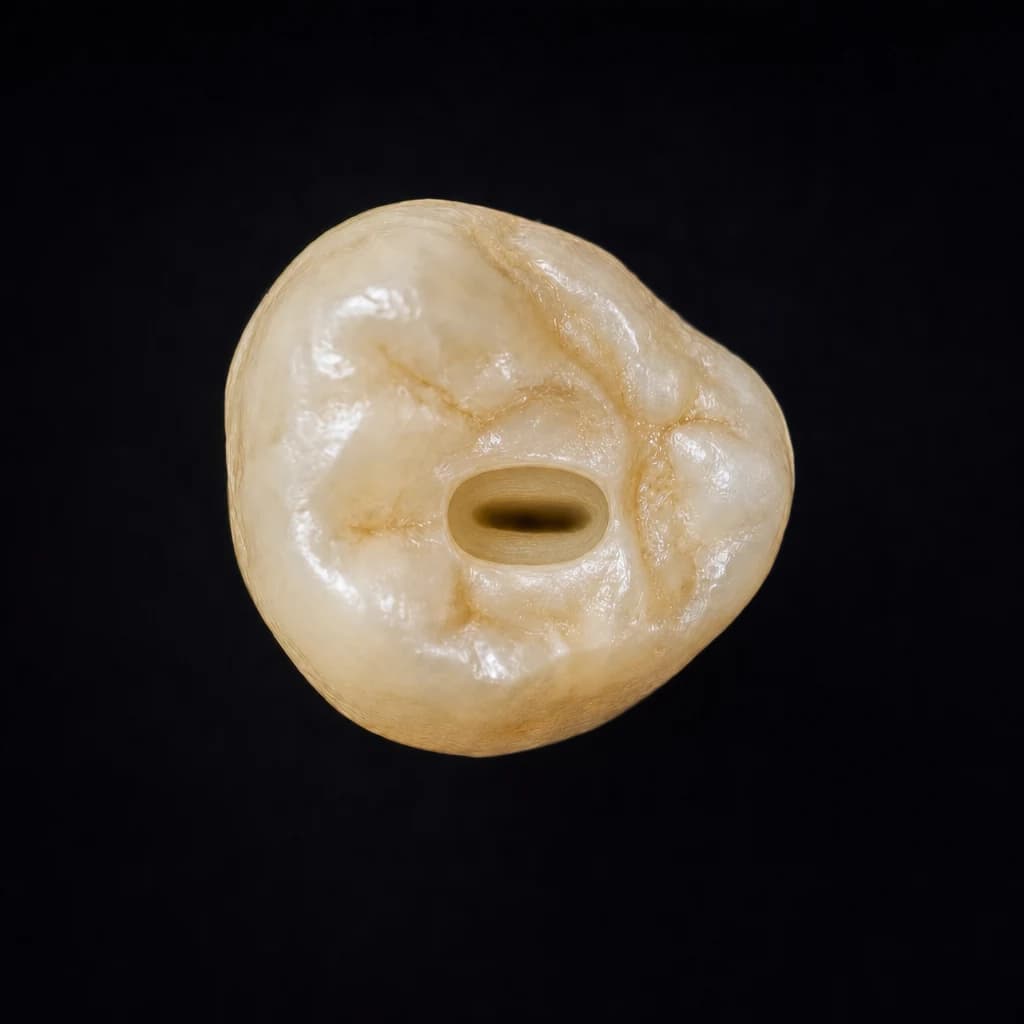
Mandibular first premolar — oval occlusal access with a single slot-shaped canal orifice
Average Length21.6 mm
Root Development12-13 years
Universal #21, 28
FDI #34, 44
Access Cavity Design
ShapeOval/Kidney
OrientationBuccolingual; bur directed buccally to compensate for lingual crown tilt
Entry PointThrough occlusal surface toward buccal cusp; may require buccal cusp reduction for straight-line access
Landmarks
- Buccal cusp tip as primary reference for access direction
- CEJ center on buccal surface — aim bur toward this point
Do Not Invade
- Lingual wall (thin — highest perforation risk zone)
Canal Anatomy
Configurations
Single canal (Vertucci Type I)61-76%
Two canals (Vertucci Type II/III/IV/V)5-24%
Three canals<2%
C-shaped canal system1-18% (population-dependent)
Canal Positions
MCMain Canal
May bifurcate in middle or apical third (~28% bifurcation rate); oval cross-section
BBuccal Canal
When 2 canals present; typically wider and more accessible
LLingual Canal
When 2 canals present; often narrower and harder to negotiate
Danger Zones
- ⚠Lingual perforation — crown tilts lingually relative to root axis; #1 endodontic risk for this tooth
- ⚠Direct bur buccally toward CEJ center to compensate for lingual crown tilt
- ⚠Distal root curvature in ~82% — instrument transportation and ledging risk
Clinical Tips
Technique
CBCT valuable for preoperative assessment — especially when radicular groove present or PA shows unusual anatomy
Anatomical Variations
C-Shaped Canal System
1-18% (higher in Asian populations)Continuous ribbon-shaped canal in C-configuration. Associated with radicular groove on root surface. Requires modified cleaning and obturation approach.
Access Modification: Oval to kidney-shaped access; circumferential filing for debridement; thermoplasticized obturation preferred
Bifurcated Canals (Middle Third)
~28%Single canal bifurcating into buccal and lingual canals in the middle third. Often not visible on straight PA radiograph.
Access Modification: Angled radiograph to confirm bifurcation; explore both walls with small pre-curved files
Three Canals / Three Roots
<2%Rare variant with three separate canals. Case reports document three-rooted specimens.
Access Modification: CBCT mandatory for mapping; extended access to locate all orifices; microscope recommended
Other teeth in the atlas
Maxillary