MaxillaryOvoid
Maxillary Canine
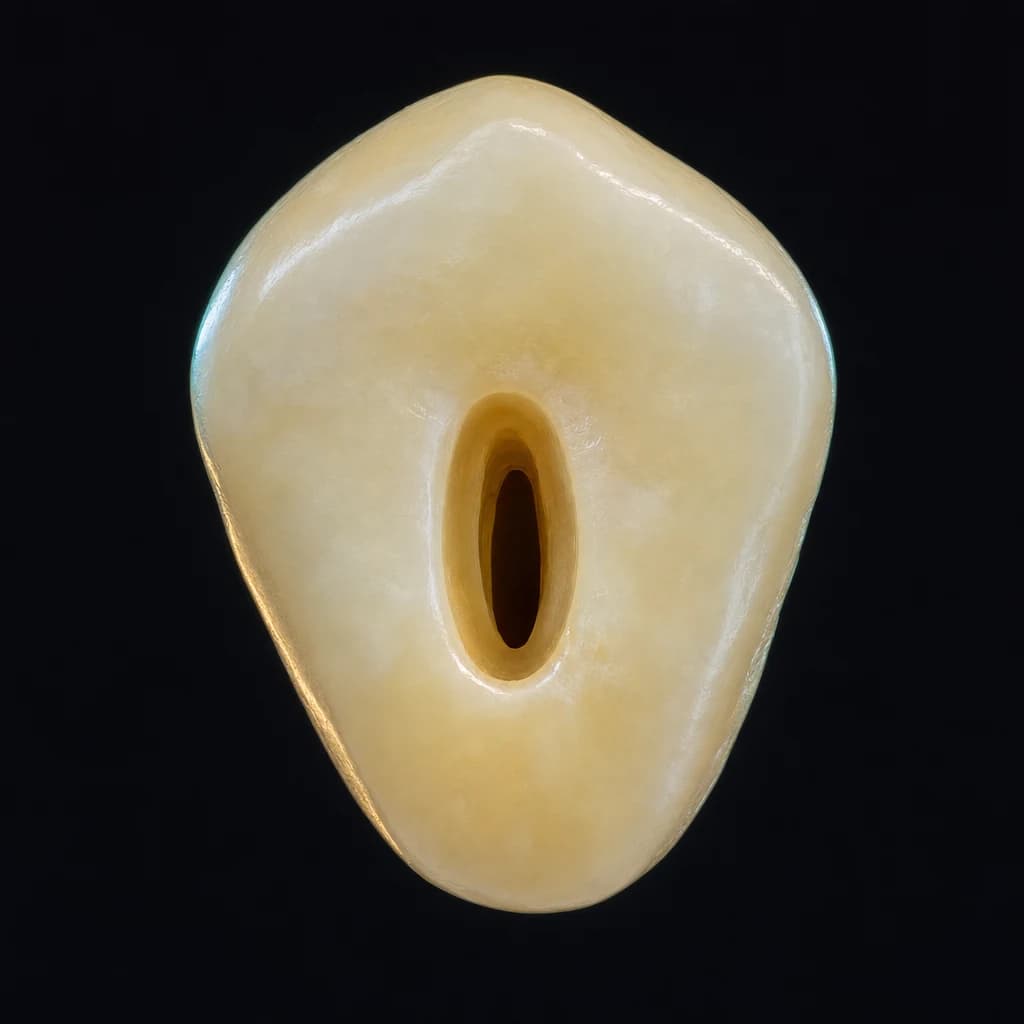
Maxillary canine — oval palatal access cavity with a single slot-shaped canal orifice
Average Length26.5 mm
Root Development14 years
Universal #6, 11
FDI #13, 23
Access Cavity Design
ShapeOvoid
OrientationLonger axis oriented labiopalatally; centered on palatal surface, extending toward incisal edge as needed
Entry PointPalatal surface, slightly below mid-crown
DimensionsM-D: 1.54 mmB-L: 2.24 mm
Landmarks
- Cusp tip as superior reference for access extent
- Cingulum as inferior boundary
Do Not Invade
- Cusp tip (preserve structural integrity of heavily functioning cusp)
- Labial wall (esthetic zone — maintain dentin thickness)
Canal Anatomy
Configurations
Single canal (Vertucci Type I)98-100%
Two canals (Vertucci Type II or III)1-2%
Canal Positions
MCMain Canal
Ovoid at cervical (mesiodistally elongated), progressively round toward apex; may curve in any direction in last 2-3 mm
BBuccal Canal
When 2 canals present (rare, Type II/III)
PPalatal Canal
When 2 canals present (rare)
Danger Zones
- ⚠Distal/palatal root surface — thin dentin wall, perforation risk during shaping
- ⚠Buccal bone fenestration over canine eminence (~27% prevalence)
- ⚠Exceptional length (26.5 mm avg) — instrument fatigue risk in apical third
Clinical Tips
Technique
Use long-shanked round burs (e.g., Endo-Z, Munce Discovery) for deep pulp chambers
Tip
May need to extend incisally for straight-line access — balance access vs. cusp preservation
Anatomical Variations
Two Canals (Type II/III)
1-2%Rare bifurcation within single root, typically Vertucci Type II (2-1) or Type III (1-2-1). Documented in case reports across multiple populations.
Access Modification: Extended labiopalatal access to locate both orifices; CBCT recommended
Root Dilaceration
~9.8%Abnormal curvature or angulation of root, mostly mild and distal in the apical third. Can complicate canal negotiation and instrumentation.
Access Modification: Pre-curve files; use flexible heat-treated NiTi; consider CBCT for severe dilaceration
Two or Three Roots
Extremely rare (isolated case reports)Supernumerary roots documented in isolated case reports. Three-rooted maxillary canines are an anatomical rarity.
Access Modification: CBCT mandatory for mapping; access extended to accommodate all orifices
Other teeth in the atlas
Maxillary