MaxillaryOvoid
Maxillary First Premolar
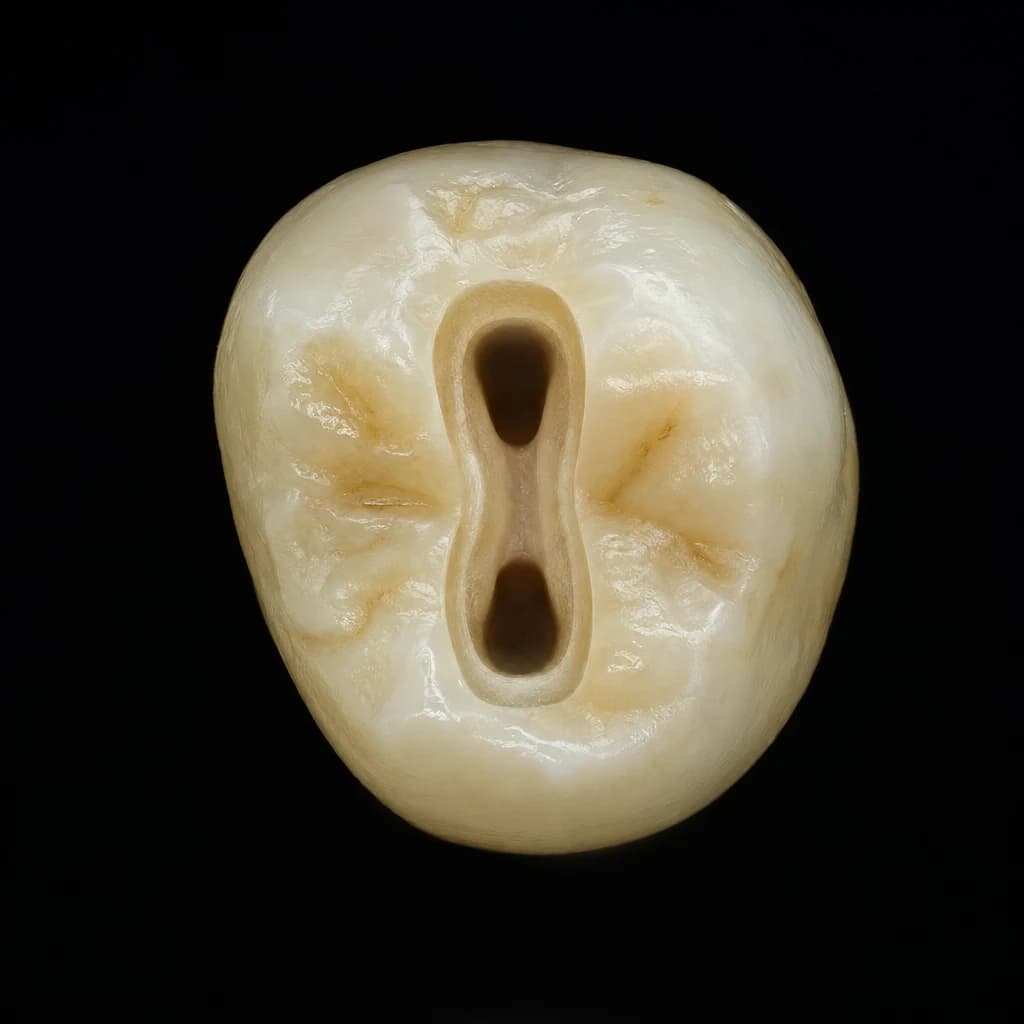
Maxillary first premolar — buccopalatal oval access with two orifices, buccal and palatal, joined by an isthmus
Average Length21.0 mm
Root Development13 years
Universal #5, 12
FDI #14, 24
Access Cavity Design
ShapeOvoid/T-Shaped
OrientationLonger axis buccopalatally; ovoid for 2-canal, T-shaped extension buccally when 3 canals suspected
Entry PointCentral occlusal surface, middle of central sulcus
Landmarks
- Cusp tips define buccopalatal extension
- Central developmental groove as guide
Do Not Invade
- Mesial marginal ridge (thin dentin over furcation groove)
Canal Anatomy
Configurations
2 canals, buccal + palatal (predominantly Vertucci Type IV)75-90%
1 canal (Vertucci Type I)8-18%
3 canals, MB + DB + P (Vertucci Type VIII)1-7.3%
Canal Positions
BBuccal Canal
Directly beneath buccal cusp tip; oval cross-section cervically, round apically; often narrower than palatal
PPalatal Canal
Directly beneath palatal cusp tip; typically wider and more accessible than buccal
MBMesiobuccal Canal
When 3 canals present — mesiobuccal to buccal cusp tip
DBDistobuccal Canal
When 3 canals present — distobuccal, often the smallest canal
Danger Zones
- ⚠Mesial concavity (furcation groove) — dentin as thin as 0.78 mm (typically <1 mm)
- ⚠Strip perforation risk zone 4-6 mm below orifice on mesial wall
- ⚠Slender buccal root — aggressive preparation risks perforation or fracture
Clinical Tips
Technique
Sieraski's Rule: Mid-root M-D radiographic width >= crown M-D width suggests 3 canals/roots
Technique
Take 2-3 angled radiographs (SLOB rule) to detect additional canals and root bifurcation
Technique
NaOCl bubble test (champagne test) can reveal hidden orifices at the pulp chamber floor
Anatomical Variations
Three-Canal Configuration (MB + DB + P)
1-7.3% (varies by ethnicity)Buccal root splits into mesiobuccal and distobuccal canals. Prevalence highest in Jamaican (~7.3%) and lower in Portuguese (~2.9%) populations.
Access Modification: Convert ovoid access to T-shaped: extend buccally to locate separate MB and DB orifices
Single Root with Fused Canals
8-18% (Vertucci Type I)Single root with single canal throughout. More common in some populations. May have wide band-shaped canal at cervical level.
Access Modification: Smaller round access cavity; verify single canal with angled radiograph before conservative preparation
Other teeth in the atlas
Maxillary