MaxillaryTriangular
Maxillary Second Molar
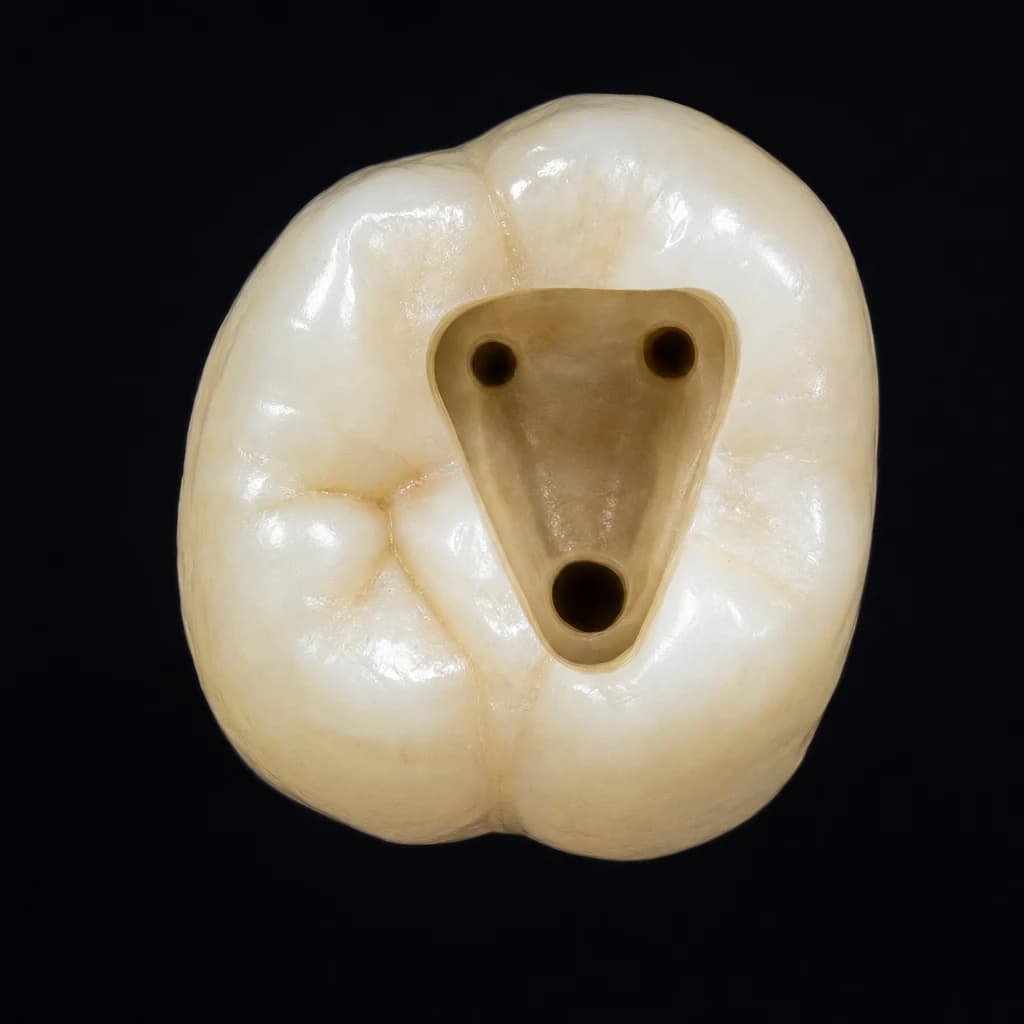
Three-canal maxillary molar access — rounded triangular outline with mesiobuccal, distobuccal and palatal orifices
Average Length20.0 mm
Root Development16 years
Universal #2, 15
FDI #17, 27
Access Cavity Design
ShapeTriangular
OrientationCompact triangle with vertices at MB, DB, P; more mesially positioned and smaller than first molar
Entry PointCentral pit, mesial two-thirds of occlusal surface
Landmarks
- Central pit as starting reference
- MB-DB-P triangle (more compact than first molar)
Do Not Invade
- Mesial marginal ridge
- Oblique ridge (when present)
Canal Anatomy
Configurations
3 canals (MB, DB, P)55-70%
4 canals (with MB2)18-33%
Fused roots (2 or fewer roots)9-40% (population-dependent)
Single root / single canal~6%
Canal Positions
MBMesiobuccal
Similar to first molar but closer to other orifices; roots more convergent
DBDistobuccal
May be very close to MB or even fused in convergent root forms
PPalatal
Largest canal; may be closer to buccal canals than in first molar
MB2Mesiobuccal 218-33%
Significantly lower prevalence than in first molar (18-33% vs 60-93%)
Danger Zones
- ⚠Maxillary sinus proximity — root apices avg 0.34 mm from sinus floor; risk of sinus perforation
- ⚠Furcation floor — closer canal orifices increase perforation risk during MB2 search
- ⚠Fused roots — altered canal geometry may confuse orientation during instrumentation
Clinical Tips
Tip
Access smaller than first molar — canal orifices much closer together; risk of gouging between canals
Tip
Restricted access due to posterior position — longer burs and good mouth opening essential
Anatomical Variations
Fused Roots
9-40% (population-dependent)Two or more roots fused together, most commonly MB+DB fusion (cone-shaped root). More common than in first molars. Alters canal geometry and orifice positions.
Access Modification: Orifices may appear nearly linear; adapt access shape to follow orifice pattern; CBCT for mapping
C-shaped Canal System
~8.3%Continuous ribbon-shaped canal connecting MB to DB in a C-configuration. More prevalent than in first molars (~2.3%).
Access Modification: Extended access to visualize full C-shape; modified instrumentation (circumferential filing); thermoplasticized obturation preferred
Single Root / Single Canal
~6%Complete root fusion into single conical root with single canal. Considered anatomical anomaly.
Access Modification: Smaller, more centered access; verify with CBCT; treat as single wide canal
Other teeth in the atlas
Maxillary